
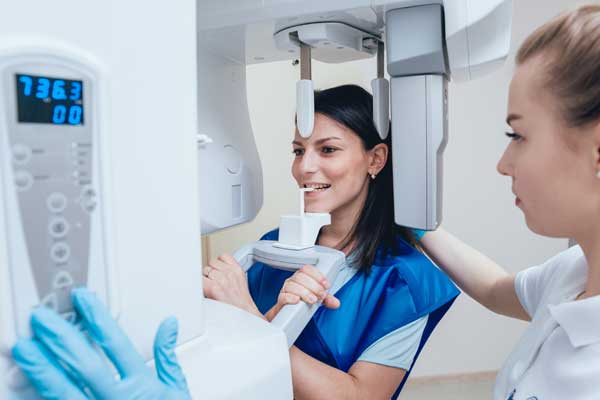
Safer Surgery. Faster Healing. It All Starts With A Scan.
When you’re getting dental implants, you want your dentist to have all the information they need to perform your surgery as safely and accurately as possible.
That’s what a CBCT scan does. It’s fast, safe, and painless for you, but gives us a crystal-clear 3D look at your mouth, jaws, and teeth, letting us plan your surgery so that it’s less invasive and has a higher chance of success.

What Sets Us Apart
- State-of-the-Art Dental Office
- 2 Convenient Locations
- All Dental Treatments Under One Roof
- Great Insurance Support (In Network With Most PPOs)
- Financing Options Available
- Prompt Service
- Friendly Staff
- Your Comfort Is Our Top Priority
Getting Your CBCT Scan
Step 1 — Visit us for a consultation
This is where you’ll learn more what a CBCT scan involves, and how it can support your dental implant procedure. If you decide to get a scan, we’ll also ask you some health questions – like whether you’re pregnant, for example – so we can prepare the appropriate safety measures.
Step 2 — Book your CBCT scan
If you decide to get a scan, you’ll be able to book an appointment during your consultation or after you go home. The scan is quick and easy – you don’t need to do anything the night before your scan, and you’ll be able to drive yourself to and from the clinic.
Step 3 — Arrive and prepare for the scan
Once you arrive, you’ll receive a brief rundown of what you can expect, then you’ll be asked to wear a shielding vest and remove your glasses and any other metal objects like jewellery that you may be wearing.
Step 4 — Complete the scan
Next, you’ll step into the scanning area of the machine, where you’ll receive directions on how to position your body and head. After that, you’ll be asked to stay still while the scan is performed, but don’t worry about getting tired – the scan only takes about 10 seconds.
Step 5 — Review the results with your dentist
Once the scan finishes, it’ll automatically transfer to a computer where your dentist will be able to review the results with you. The scan will be able to tell us if you need more dental work before getting implants, or if you can proceed with getting them right away.
Not All Dental Equipment Is Made Equal
Freedom Dental only uses the latest, top-of-the-line scanning technology from 3shape.
Increased safety
Worried about radiation? Don’t be. Our scanner captures high quality scans while only delivering very low doses.
Better accuracy
Safety doesn’t mean compromising on image quality. A unique rotating shutter lets us take detailed, crystal clear scans.
Improved comfort
Forget about head clamps and laser guides. ScanComfort technology makes your scanning experience simpler, faster, and more comfortable.
Frequently Asked Questions About CBCT Scan
What is a CBCT scan, and how does it differ from a regular dental X-ray?
A CBCT scan, or Cone Beam Computed Tomography scan, captures detailed three-dimensional images of the teeth, jawbone, nerves, and surrounding structures. Traditional dental X-rays produce flat, two-dimensional images that can limit depth and perspective. CBCT imaging allows dentists to view anatomy from multiple angles, improving accuracy when evaluating complex dental conditions or planning treatment.
Why might my dentist recommend a CBCT scan?
CBCT scans are often recommended when precise imaging is needed beyond what standard X-rays can provide. Common uses include dental implant planning, assessing jawbone structure, locating nerves, and evaluating impacted teeth. The detailed views help dentists make informed decisions and reduce uncertainty during treatment planning.
Are CBCT scans safe?
CBCT scans are considered safe when used appropriately. While they involve more radiation than a single dental X-ray, the exposure is still much lower than that of a medical CT scan. Dentists follow strict safety guidelines, using CBCT imaging only when the diagnostic benefit outweighs the exposure and applying the lowest effective dose.
How should I prepare for a CBCT scan?
Preparation is simple and minimal. Patients are usually asked to remove metal items such as jewelry, glasses, or hair accessories that could interfere with image quality. In most cases, there are no dietary restrictions or special clothing requirements unless the dental office provides specific instructions beforehand.
What can I expect during the CBCT scan procedure?
The CBCT scan is quick and non-invasive. You may be seated or standing while the machine rotates around your head for a short period. Remaining still helps ensure clear images. The scan typically takes under a minute and does not cause pain or discomfort.
How are the results of a CBCT scan used by my dentist?
Dentists use CBCT images to closely examine bone density, tooth positioning, nerve pathways, and signs of infection or damage. This information is especially valuable for procedures such as dental implants, surgical planning, and complex restorations. Detailed imaging supports more precise treatment and improved outcomes.
Will my insurance cover the cost of a CBCT scan?
The insurance coverage for CBCT scans differs based on the specific plan and the purpose of the scan. Some providers offer partial coverage for advanced imaging when it is considered medically necessary. Patients are encouraged to check with their insurance company and discuss costs with the dental office before the scan is performed.
How long does it take to receive CBCT scan results?
In most cases, CBCT images are available immediately after the scan. Dentists can review the images during the same appointment or shortly afterward. This allows treatment discussions and planning to move forward without long delays, especially for time-sensitive procedures.
Can a CBCT scan detect problems that regular exams might miss?
Yes. Since CBCT scans provide three-dimensional detail, they can reveal issues such as hidden infections, bone defects, impacted teeth, and anatomical variations that may not be apparent on traditional X-rays. This added visibility helps dentists identify concerns earlier and plan more targeted care.
How often does a patient need a CBCT scan?
CBCT scans are not routinely performed and are recommended only when clinically necessary. The frequency depends on individual treatment needs, such as implant planning or surgical evaluation. Dentists prioritize minimizing radiation exposure by limiting scans to situations where advanced imaging provides clear diagnostic value.
Make Your Dental Implants A Success
Avoid potential complications and give yourself the best possible chance of a successful dental implants procedure. Schedule your CBCT scan consultation today, and enjoy the convenience and comfort of problem-free dental implants for decades to come.

Connect with Dr. Cheng Zhu on